What Are the Advantages and Challenges of Special Foundry Sands?
Quartz sand features abundant mineral reserves, relatively low cost and simple processing procedures, making it the most widely-used base foundry sand in domestic foundries. Meanwhile, significant breakthroughs and mature industrial applications have been achieved in waste sand reclamation technology. In recent years, driven by continuously upgraded industrial technical standards and customer requirements, the inherent material properties of quartz sand have become an obvious bottleneck for further improvement of casting quality. This impact is particularly prominent on the inner-surface cleanliness of critical and complex castings. Against this background, special foundry sands have been developed and adopted.
In a broad sense, special foundry sands fall into two categories: natural special sands and synthetic special sands. Natural special sands mainly include zircon sand, chromite sand and aluminosilicate sand. Due to scarce domestic mineral deposits, high cost of imported raw materials and complicated manufacturing processes, natural special sands are seldom applied in mass foundry production. Synthetic special sands generally refer to ceramic-bead sand and ceramsite sand, which are produced from bauxite via electro-fusion and sintering respectively. Thanks to favorable grain shape, high refractoriness and low thermal expansion coefficient, synthetic special sands have gained extensive application in domestic foundries in recent years.
1. Key Properties and Advantages of Special Foundry Sands
Literature indicates that ceramic-bead sand is manufactured by blowing molten electro-fused feedstock into spherical particles, while ceramsite sand is produced by granulating ground raw materials with water spray followed by rotary sintering. Both sands exhibit well-rounded grains and low angularity coefficient. During core-shooting operations, the spherical grain morphology improves base-sand flowability and yields sand cores with higher compactness. Consequently, they deliver enhanced resistance to molten-metal penetration and excellent anti-burn-on performance.
Different from quartz sand, special foundry sands contain high alumina Al2O3 content, ranging from 40 % to 80 % depending on sand grade. Alumina forms mullite phase with exceptional thermal stability. Therefore, special foundry sands possess outstanding anti-sintering performance under thermal attack of high-temperature molten metal. Such superiority is more remarkable for thin-walled, intricately-structured sand cores compared with conventional quartz sand.
Likewise, owing to the mullite-phase constituent, special foundry sands have relatively low high-temperature thermal expansion coefficients. Further enhanced dimensional stability is achieved through high-temperature electro-fusion or calcination during production. Its effectiveness in addressing vein defects — a persistent problem for foundries adopting cold-box processes — has been well-recognized by industry experts. Blending special sands has become a common process measure for sand cores such as intake/exhaust ports of engine cylinder heads, tappet bores and water-jacket passages of engine cylinder blocks.
2. Practical Problems and Countermeasures in Special Foundry Sand Application
Despite the numerous merits mentioned above, several limitations and risks have been identified in real-world production practice, summarized as follows:
(1) The purchase price of special foundry sands is 5-10 times higher than that of quartz sand, or even more, imposing substantial cost pressure on foundries. To leverage the strengths of special sands while minimizing material costs, foundries commonly blend base sand with 30 %-70 % special sand. This blending practice effectively mitigates inner-surface defects such as metal penetration, sintering and vein defects. When vein defects fluctuate at low special-sand blending ratios, addition of 0.3 %-0.5 % high-efficiency composite anti-vein agent is recommended.
(2) Under certain conditions, especially for low-grade special sands, poor shake-out performance may occur. As previously stated, special sands feature rounder grains and better flowability than quartz sand. With identical resin addition rates, sand cores produced from special sands achieve higher compactness and strength, which tend to degrade shake-out performance after pouring. Black sand residues frequently remain on casting inner surfaces after core removal and cleaning, lowering cleaning efficiency and increasing risks of non-conforming products escaping inspection. To resolve black-sand defects, besides moderately reducing resin dosage, foundries need to introduce additional procedures such as post-pouring stress-relief annealing, vibratory core knockout and even inner-surface shot blasting to fully eliminate black-sand contamination of inner-wall surfaces.
(3) Special sands may carry significant sintering risk. This may appear contradictory to their good anti-sintering capability described earlier; however, the contradiction can be clarified dialectically. High-grade special sands with low impurity content show superior anti-sintering properties. By contrast, low-grade special sands containing excessive alkali metals and alkali-metal oxides exhibit poor resistance against sintering, readily triggering sintering defects on casting inner surfaces after pouring (Figure 4), particularly in narrow zones subjected to intense thermal loading on sand cores.
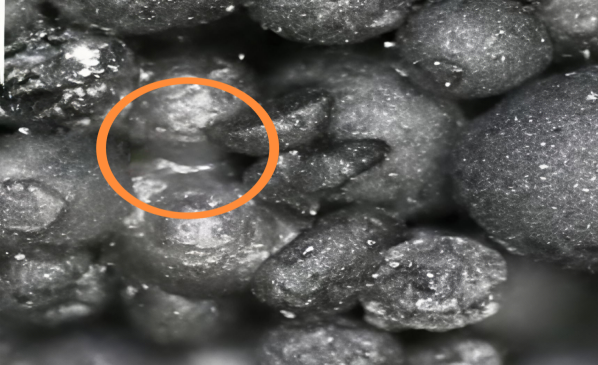
Figure 4 Magnified view of sintering on special-sand grains
Generally, most foundries lack in-house capabilities to analyze chemical composition and grade of incoming special sands and have to fully rely on the reliability and consistency of raw-material suppliers. A simple but practical field assessment method adopted by some foundries is to estimate sand grade by measuring the amount of magnetic substances captured via magnetic-bar adsorption test (Figure 5).
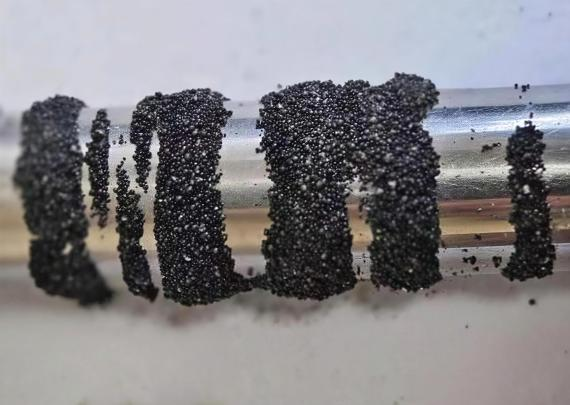
Figure 5 Magnetic-bar adsorption test for special foundry sand
For production of critical and complex castings, special foundry sands effectively alleviate challenging inner-surface defects including metal penetration, sintering and vein defects, and play an irreplaceable role in improving inner-surface cleanliness. Meanwhile, material costs can be reduced and quality defects suppressed by adjusting sand blending ratios and optimizing process workflows.
It should be emphasized that strict quality control of special sands and minimization of impurities (alkali metals and their oxides) constitute a core concern that cannot be overlooked in practical application.
Copyright Notice: This content is original and exclusive. All rights reserved. Reprinting, reproduction and commercial use are prohibited without authorization. Violators shall be held accountable!